Home
INDUSTRIAL OVENS
Conveyor Ovens
Inert Atmosphere Ovens
Vertical Ovens
Batch Ovens
Indexing Ovens
Specialty Custom Ovens
AUTOMOTIVE OVENS
Engine Components
Friction Material
Interior Components
Additional Automotive Equipment
CUSTOM EQUIPMENT FABRICATION
Conveyors & Materials Handling
Process Equipment
Automated Equipment
Teppanyaki Grill
CUSTOM QUOTE
 
Skip Navigation Links

Indexing Ovens

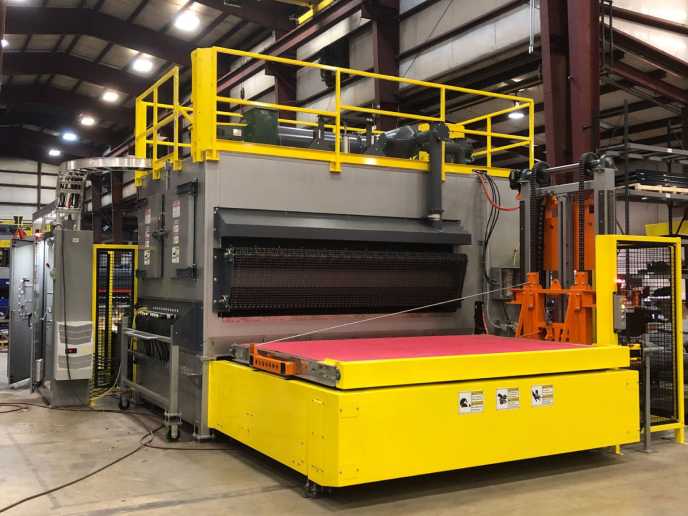
Indexing ovens are a type of conveyor oven that allows product to move through the heated chamber in steps, instead of continuous travel, like a conventional conveyor oven. The control system initiates the movement of the conveyor system to move a group or groups of product, for process, for a specified distance. When motion stops the product remains in that position for a predetermined amount of time until the next index motion. Indexing oven systems allows groups of product, or products, to be moved through the heated chamber in steps. These index type operation creates more process options and flexibility for the customer.

The heated chamber can be divided into multiple zones to allow various temperature set points and process time flexibility during the thermal process. Each zone can include a specified number of positions to determine processing time in that particular heated zone. Indexing ovens normally include automatic vertical doors between the heated zones and at each end of the chamber to reduce heat loss and increase process uniformity. Indexing ovens are also used for applications that require custom tooling, or trays, for the conveyor system to hold parts during process.

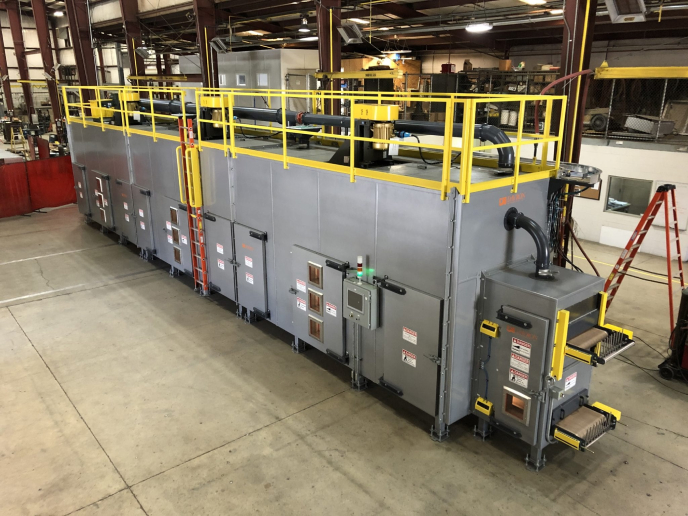
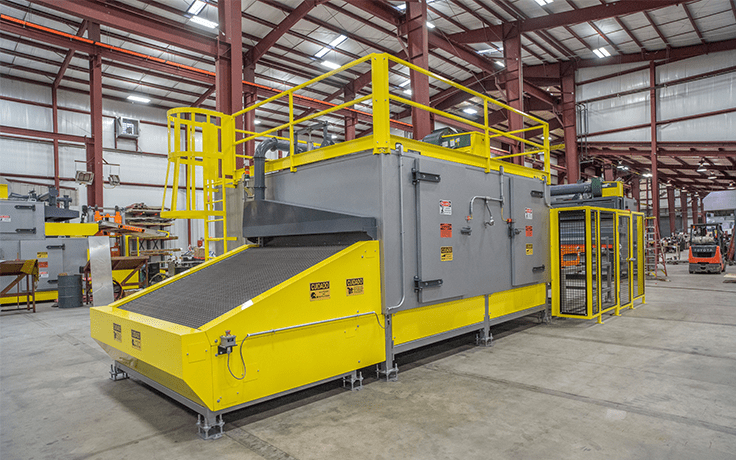
Indexing ovens are very similar to conveyor ovens, or continuous ovens, with the exception of the actual conveyor system. Davron fabricates indexing ovens in virtually any combination of width and length to meet any process requirements. These ovens can be heated by various heat sources, including electric or natural gas heating systems as with any normal conveyor or continuous oven.

Davron indexing ovens can be used for practically any thermal process that requires a product to be heated, cured, or dried in the temperature range of 150 to 1200 degrees F. Many different conveyor types and airflows are available to provide flexibility to convey and heat your product. Oven solutions are available for solvent processing as well. Oven systems can also include cooling sections if required by the process. Our staff will work with you to create a solution to meet your process needs.

All Davron ovens are custom designed and built for your specific process requirements and meet NFPA, OSHA, and NEC requirements as well as insurance standards. Ovens can also be certified for UL or CE compliance if required.

The following processes are a partial list of industries using our index ovens:
  • Preheat Requirements prior to other processes.
  • Thermal Curing or Drying of molded parts.
  • Thermal processes that require ramp and soak at multiple temperatures to complete the process.
  • Heat Treating, Annealing, Aging of metals.
  • Drying of Water or Solvents

Standard Features

  • Welded structural steel framework for overall support
  • Heavy gauge aluminized or stainless steel interior sheeting and air distribution systems.
  • Heavy gauge paint grip exterior sheeting primed and painted with high temperature oven class paint.
  • Our ovens are not constructed of “tongue and groove” panels. Our construction technique provides a finished product that can be handled as a single piece or in bolt together modules on large systems for ease of installation.
  • Hinged access doors are provided for maintenance and cleaning access along the length of the equipment.
  • A combination of accurate temperature control, temperature uniformity within the heated chamber, and conveyor operation provide the high level of control required for a successful thermal process.
  • Simple digital controls for basic operation or PLC controls for complex requirements. Systems can also communicate with plant networks if required.

Indexing Ovens
 
Indexing Oven Illustration
  1. Aluminized steel interiors on standard equipment. Interiors also available in galvanized, aluminum and various grades of stainless steel. Expansion joints formed into the metal interior at the seams double as integral supports for the ovens interior. These self supporting thermal expansion joints allow the oven interior to have minimal contact to the external structure. Minimal contact minimizes heat transfer to the exterior.
  2. High density insulation selected for minimal heat loss based on operating temperature.
  3. Structural steel main frame with welded construction.
  4. 16-Gauge coated steel exterior primed and painted. Also available in galvanized, stainless steel or aluminum.
  5. Structural steel intermediate frame
  6. A wide variety of belts available including steel, stainless steel, coated fabrics & plastic.
  7. Double insulated doors with gaskets minimize heat transfer and heat loss.
  8. Explosion relief door latches to meet NFPA standards.
  9. Heavy-Duty custom built door hinges eliminate door sag and misalignment.
  10. Supply plenum openings evenly distribute air toward the product and the conveyor belt system.
  11. High velocity airflow over high watt density elements provide superior heat transfer. Electric elements shown. Also available with direct or indirect fired gas heating systems.
  12. Return plenum openings ensure air is returned through the conveyor belt evenly across the width and length of the chamber.
  13. Plug style recirculation fans have higher efficiency and less heat loss than external caged style blowers.
  14. Vertically actuated, guillotine style doors can be located at the entrance end, exit end and between internal oven zones. Vertical doors at the entrance and exit end minimize heat loss through conveyor openings at each end. Vertical doors can be added to separate internal zones. This separation provides the ability to have different set point temperatures within the same oven to create ramp and soak profiles required for some processes. A cooling zone can also be added as the last zone if required.